

As machine learning algorithms increasingly power Google Ads, it’s more important than ever to have a well-structured account. In this post, I’ll give you a short overview of what goes into a well-structured account and how to optimize your account for machine learning whilst gaining better performance marketing insights.
What is a well-structured Google Ads account?
A well-structured account is one that is organized in a way that makes sense for both humans and machines. That means having a clear hierarchy with distinct campaigns and ad groups, well-written ad copy, and relevant keywords. It also means taking advantage of all the features that Google offers, such as Dynamic Search Ads and Smart Bidding over time.
Why is it important to structure your account for machine learning?
Machines are only as good as the data they’re given. If your account is poorly structured, it will be difficult for the machine learning algorithms to understand what’s going on and make decisions accordingly. By contrast, if your account is well-organized, it will be easier for the algorithms to learn and make better decisions over time. In short, a well-structured account will help you get the most out of machine learning.
How do you structure your account for machine learning?
Let’s say you start optimizing your Google Ads campaigns for machine learning. How exactly would you go about that?
The exciting thing here is that some of the common recommendations are contradictory to established best practices. That’s why I put together a list of the most notable best practices:
Simplify your account structure
It is all about simplification now. A granular account structure used to be the recommended approach. Nowadays, I would recommend having a more holistic approach and keeping the structure simple. For example, by doing Brand and Non-Brand campaigns, Remarketing Lists for Search Ads, and maybe even pMax campaigns.
Remove unnecessary splits
A common practice here would also be to split campaigns and ad groups according to different principles. For example, account managers would separate ad groups or even campaigns for different match types, separate desktop, and mobile campaigns, etc.
Splits can be beneficial, but not in this super detailed and granular way. Keeping the splits simple enables a more holistic overview of your campaign and your goals.
Don’t refrain from using Broad Match keywords
Many advertisers have wanted to only target the exact search queries they’ve chosen. Due to their granular approach, broad match keywords and broad match modifiers were common practices.
Google seems to have been removing the functionality of more precise keyword options, and the exact match is no longer “exact”. Exact and phrase match function now pretty much equally. Using them can still be viable in case your daily budget is restricted. Besides, using broad-match keywords can easily get out of hand.
Also, pay attention to the relevance of your ad copy and the keywords. Together with the speed, quality, and user-friendliness of your website/ final URL, the Quality Score of your Ads also improves. The higher the Click-Through rate, the higher the Quality Score.
Use Ad Group Assets and Location Exclusions
Giving yourself a head start is always beneficial. If your campaign is structured well from the very beginning, the higher the chances of having a well-running campaign on your hands.
It couldn’t be easier than setting up at least four Sitelink and Callout Assets. Also making sure you reach your audience, by excluding certain locations, might at least improve your changes from the very beginning.
I will go into more detail in a future blog. 😉

What Google says how Ad Auction should be:
- Ad rank = Bid x Quality Score
According to Google, the Ads you make, win auctions if your bid and the Quality Score are right. The Quality score is based on many factors, but some of the most important ones are
- The relevance of your ad to what people are searching for (click-through rate)
- The relevance of your ad, and your landing page to what people are searching for (relevance and landings page experience)
- How often do people who see your ad end up taking the actions you want them to take (ad engagement and conversion rates)
- The freshness of your ad and your website’s content (recentness)
- Your historical Google Ads performance (historical click-through rate, landing page experience, and so on)
The better the match between what people are searching for and what you’re offering, the higher your ad will rank. Ads that drive clicks and conversions will have a higher Quality Score.
The Truth about the Ad Auction
Ad rank = CPC bid * Quality Score
= CPC bid ∗ click-through probability
= 𝐶𝑜𝑠𝑡/𝐶𝑙𝑖𝑐𝑘𝑠∗𝐶𝑙𝑖𝑐𝑘𝑠/𝐼𝑚𝑝𝑟𝑒𝑠𝑠𝑖𝑜𝑛
= 𝐶𝑜𝑠𝑡/𝐼𝑚𝑝𝑟𝑒𝑠𝑠𝑖𝑜𝑛 = a bid for an ad impression
The truth is that in the end, we do not pay for a click, but rather for an ad impression.
This shift in focus from clicks to ad impressions results from machine learning, which we do have to use to our advantage.
2 Sides of Click-through Probability
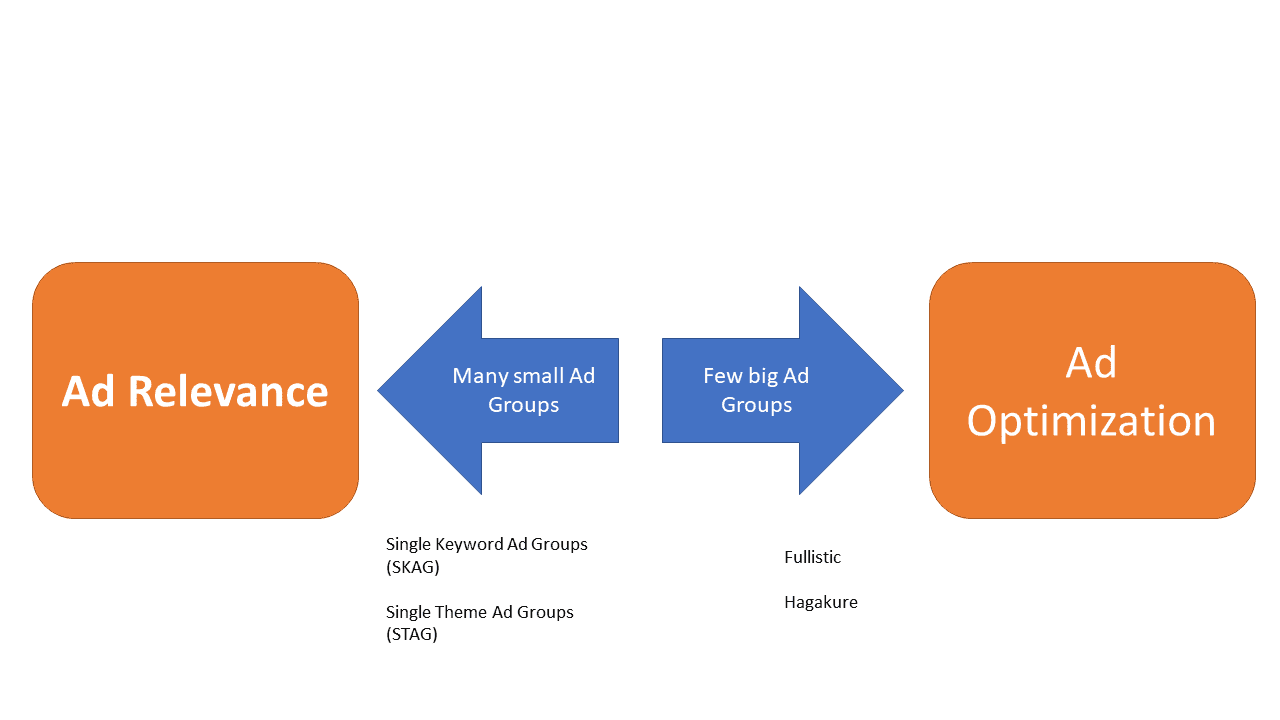
Side 1
of Click-through Probability is the Ad relevance, which contains the Ad, Keywords and the Query itself. In order to achieve Ad Relevance, Accounts were structured in many small ad groups. Strategies like Single Keyword Ad Group (SKAGs) and Single Theme Ad Group (STAGs) were the norm.
For a long time, finely granular ad group, campaign and account structures were considered the best way to buy traffic as efficiently as possible and to run Google Ads profitably.
The campaigns were structured in such a way that the account manager always knew exactly which ad groups were hidden behind which campaign and which keywords and search queries were hidden behind which ad group. Traffic was split into match types, devices and user groups, for example.
This type of structure was perfect for maintaining an overview and making targeted optimizations and bid adjustments to the individual small adjusting screws.
However, the days of humans turning the small adjusting screws are over. In recent years, Google’s smart bidding tools and intelligent bidding strategies, such as the target ROAS and the target CPA, have become increasingly precise.
All the set screws that humans could only see before because they built up the Google Ads account in a fine-grained way can be captured and evaluated holistically by these smart algorithms.
For Google, campaigns don’t necessarily have to be split into Remarketing Lists for Search Ads (RLSA) and regular search. For Google, ad groups don’t have to be split into exact and broadly matching keyword options either, because the algorithms see all of this information directly when a user is on the platform and makes a search query.
However, depending on the stage you are with your campaigns, a split in Broad and Exact Match ad groups in combination with negative Keyword-Lists might make sense.
A granular, human-matched structure is not only unnecessary for bidding strategies but can be rather a hindrance to the algorithm’s performance.
Old Google Ads account structures are designed to be as clear as possible. Traffic is split into many individual parts, creating Data Silos. These data silos are good if you need to manually optimize an account, as was necessary a few years ago.
Side 2
of Click-through Probability is Ad optimization, with which we use the Data and algorithm provided by Google networks to our advantage. Here the Fullistic Approach* and the Hagakure Approach* are good examples. I will soon go into more detail on these approaches in future articles.
Dynamic Keyword Insertion
Dynamic Keyword Insertion (DKI) or Smart Bidding can be used for Ad Optimization.
Smart bidding is a set of machine learning-powered automated bid strategies that use aggregated and anonymized data from millions of past auctions—as well as other contextual signals like device, time of day, location, and searcher intent—to optimize bids with the goal of achieving specific conversion or revenue goals.
With smart bidding, you’re entrusting Google’s algorithms to make real-time decisions on your behalf in order to improve Conversion Rates or Return on Ad Spent (ROAS).
With Dynamic Keyword Insertion, I would use it in at least one headline and combine it with keyword URLs for individual landing pages.
Pros
Cons
This is however only a portion of the solution to achieve Ad Optimization.
Ad Customizers
Responsive Search Ad Customizers are the next generation of DKI. Google Ad Customizers allow you to insert information that is specific to the searcher, such as location, time, or even custom parameters that you define, into your ads before they are served.
Available at keyword level
Easy to use
Ad Optimization: Things to Try Out
Look at different ways to combine Responsive Search Ads (RSA). This can happen in many different ways, for example by testing different Landing Pages with various approaches, depending on your product or service.
AB-Testing and Experiments are your best friends to optimize your campaigns. Always keep a lookout for RSA combinations.
I would also try out ad group-level assets, and use structured ad customizers for assets.
Combine & Conquer
Combined bid strategies get better results. For instance, with the combination of a portfolio strategy + shared budget. The approach here would combine as much as possible.
What about brand terms? Maybe don’t include them, or create a separate campaign to target Brand and Non-Brand. Google Ads’ pMax campaigns are still a viable option here.
Use Scripts for a better performance
Use scripts to increase the performance of your campaigns and automate more boring PPC tasks. There is a wide range of automation that can be achieved and make your life easier.
Nils Rooijmans is a great PPC marketer that runs a blog about Google Ads scripts, which I can highly recommend.
In case you are interested, here you can read his blog on 7 Reasons Why You Should Be Using Google Ads Scripts.
Conclusion
Machine learning is playing an increasingly important role in Google Ads, so it’s more important than ever to have a well-structured account. A well-structured account is one that is organized in a way that makes sense for both humans and machines. That means having a clear hierarchy with distinct campaigns and ad groups, well-written ad copy, and relevant keywords.
Your Account structure should be included in your strategy and be a vital part of it. Ad groups should revolve around a message. Having a good account structure is the guide to optimization. This is why combining and dividing bid strategies tend to get the best results.
By following these tips, you can optimize your account for machine learning and get the most out of this powerful tool. Your business is your structure!
Additional Reading/ Recommendations
Performance Marketing – 16 Things you need to know to get started in performance based Marketing
Nils Rooijmans- Boosting Google Ads Performance by using Scrips
